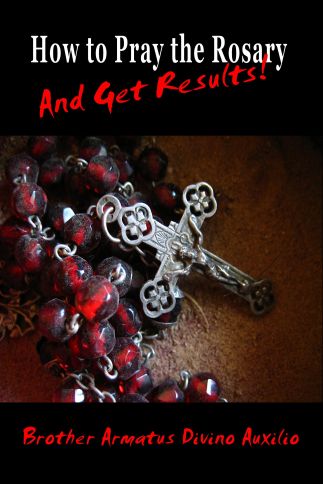
NEW BOOK: How to Pray the Rosary and Get Results

rosary-front1

WEAPONIZE YOUR ROSARY!

If you’re any sort of Christian magician, you already know the Rosary is hot stuff. More than that, the Rosary is a weapon. Yet in untrained hands, any weapon is bound to miss its target.

How to Pray the Rosary and Get Results answers that problem. This book gives the training in how to handle, field-strip, and fire your weapon.

You’ll learn:

* What the Rosary is and where it comes from.
* The Seven Keys of Effective Prayer.
* The Protestant Rosary
* How the traditional 15 Mysteries can work for you.
* Pathworking to intensify the Mysteries’ assistance in your life.
* The Expanded Method that amplifies your Rosary prayers.
* How to diagnose and fix problems with prayer.

With this book, no longer will you feel like you’re striking with a dull blade. Instead you’ll have the tools to fine-tune your weapon and make it strike true.

Available in Kindle ($5.99) and Paperback ($11.99).

Posted in Rituals and Spells, Self Improvement | Tagged , , | 1 Comment

Invocation of Cassiel the Archangel

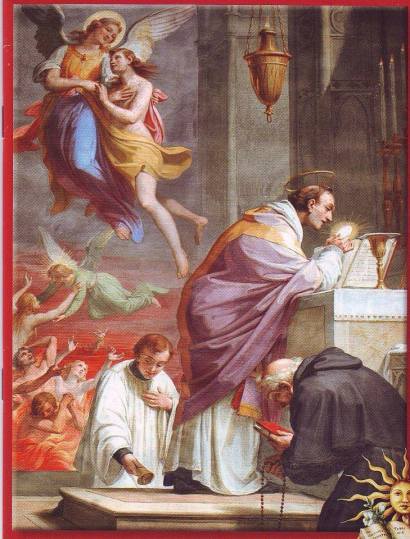
cassiel

Painting Credit: Michael Waters, 2006

If you’ve been following the posts on the Catholic and Orthodox Esotericism group, you’ll be aware of the prayer book I’ve been developing. I’d like to share with you an excerpt, a prayer I composed to the Archangel Camael.

When finished, the prayer book will be released as a free .pdf file on this website, with option for a print version at my cost on lulu.com. For now, here’s the prayer:

214. Invocation of St. Cassiel
Holy Cassiel the archangel: angel of time, angel of peace, angel of temperance and moderation. You stand before the throne of God the Father, interceding on behalf of the Church Militant as we build up his Kingdom.
You minster before God the Son, wiping his tears at the Redeeming moment of his crucifixion.
You travel with God the Holy Ghost, administering time and witnessing the grace infused into all creation.
You carry a sword of lightning, defending against all who would encroach into the Highest’s realm.
Hear me as I come before you, not as an interloper but as one redeemed in the Son’s most precious Blood.
Hear me as I come before you, not as a proud man (woman) but as one humbled by the responsibilities I bear.
Hear me as I come before you, not as one rich in grace but impoverished and seeking an infusion of Divine Energy.
Raise up your sword against those who would do me harm.
Raise up your tempest to drive away my pride and immoderation.
Raise up your light to fill me with the energy of the Holy Ghost.
And of all these things, raise up your bow and let your arrows fly to the heart of my intention (here name it), that once it is manifest, I will praise your intercession and give glory to God the Father!
I will praise your intercession and give glory to God the Son!
I will praise your intercession and give glory to God the Holy Ghost!
Praise and glory and honor and power unto the ages of ages. Amen!

Posted in Rituals and Spells | Tagged , , , , | 7 Comments

The Magic of Catholicism – Official Trailer

I’ve got a lot of downtime this weekend, so it’s finally here – a book trailer for The Magic of Catholicism: Real Magic for Devout Catholics!

The trailer follows my lines of thinking when writing the book, that most books on “Catholic magic” either talk conspiracy theories or peripheries (i.e. folk magic), while I’d prefer to talk about what’s actually there in the official Catholic tradition.

That’s why there’s so much overkill with giving sources, footnotes, and citations, because this is ground a lot of people don’t want to believe exists, and so it seemed necessary to spell it out and spoon-feed the information every step of the way.

So if you’re looking to learn exactly how the Catholic Church is an initiatory magical system, exactly how magic pervades every aspect of official Catholic theology, and how you can put that magic to for you, then this is the book you’ve been waiting for!

Next up: a trailer for this book’s companion volume, Ritual Magic for Conservative Christians.

Posted in Magical Theory, Rituals and Spells, Theology, Uncategorized | Tagged , , , , | Leave a comment

The “Christmas Is Pagan” Diatribe

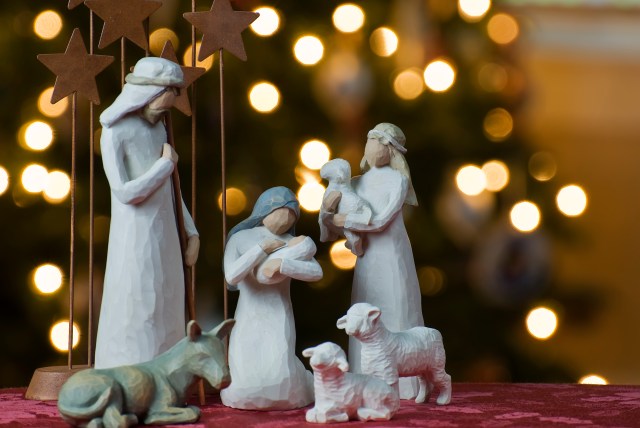
nativity_tree2011

It’s that time of year, when social media is filled with posts about how Christmas is a “Pagan” holiday. So much fun!

It’s a charge often put forward by anti-Christians as if it somehow de-legitimizes Christianity. My own attitude is “So what?”

You see, religion doesn’t start in a vacuum, and each new religious movement is certain to borrow elements from traditions that came before it. New converts will likewise keep their family customs – albeit with reorientation them to their new theology – and entire societies will do the same with regional or civic traditions. It’s been done over and again more times than we can possibly know, and it’s simply the way of human nature.

This is important, because the accusation that Christmas is “pagan” has nothing to do with the REASON for Christmas, but everything to do with the CUSTOMS surrounding it, such as the date (though disputed), the practices of burning yule logs and hanging mistletoe, the image of Santa Claus/Father Christmas, the whole shebang. This is where the argument is strongest, and also where it falls apart.

The argument is strongest because it contains elements of truth, elements the Church happily admitted prior to Vatican II, and that most Traditional Catholics have no problem admitting today.

Yet the argument also falls apart on this point, precisely because it’s based on a false premise: the Protestant premise that just because something may be “pagan,” it’s automatically “evil” and therefore must be avoided. Not only is this rooted in a naïve sense of puritanism and sets up a false dichotomy of “us versus them,” it also places limits on God’s power to share His message with people and groups according to their ability, and likewise denies the reality of Natural Revelation which exists amongst all peoples.

No, the process of religious conversion and interaction amongst groups of faith is never that simple. Rather, it’s always complicated and messy especially as people live, work, breathe, and breed in the context of pluralistic societies. A rigid puritanical lens cannot be used to gain an accurate understanding of any holiday, not even modern ones such as Humanlight or made-up ones like Festivus. Every celebration is laid on a foundation of something that preceded it, and I believe that – instead of blaming our ancestors for “impurity” or whatever – we should thank them for preserving their traditions so that we may observe them today.

Posted in Uncategorized | Tagged , , , , | Leave a comment

The Lord’s Prayer as Spiritual Technology

A few weeks ago I was talking religion with some friends, and one of them claimed the Our Father (the Lord’s Prayer) plays into a mindset of blind obedience and unquestioning submission.

This guy was raised Protestant, and Reformed Protestantism isn’t exactly known for its richness of mystical or spiritual teaching. So I took this as an opportunity to explain the value of the Lord’s Prayer.

Posted in Magical Theory, Theology | Tagged , , , , , , , | Leave a comment

Can We Pray to Spirits and Dead People?

halloween_sweden-wikipedia-public-domain

Swedish Lutherans Celebrate Halloween (Source: Wikipedia)

It’s that time of year when the Triduum of Halloween-All Saints-All Souls is upon us. Usually around this time people ask me these questions, or something like them: is it sinful to venerate our ancestors? What about spirits like the Lwa and Orishas?

While the Cliff Notes answer is “yes it can be done,” there’s more that we need to be aware of. So I ask you indulge me while we journey together.

In the case of our ancestors and other dead people, we have to think in terms of the Church Triumphant and the Church Suffering, discussed in Chapter 6 of The Magic of Catholicism.

According to Catholic teaching:

1. Saints are dead people.
2. When you pray to a Saint, you’re praying to a dead person.

Now let’s add a little more to the mix. Catholicism also says:

3. A Saint is any dead person who made it to heaven.
4. The Church admits that she’s not capable of knowing the identity of every person who became a Saint. She is only able to pronounce on those her officials have been able to examine.

For those who didn’t become Saints, they most likely ended up in Purgatory and are part of the Church Suffering. To this, Catholicism teaches:

5. The souls in Purgatory cannot pray for themselves, but
6. The souls in Purgatory can intercede for us. (not official teaching, but strongly documented)

So in conclusion, the answer is YES. You can venerate your ancestors and your honored dead in the same vein as you would venerate a Saint. The rule is that you offer them dulia (“reverence”) and not latria (“worship,” reserved for God alone).

This clears up confusion on the question of ancestors, honored dead, and dead humans in general. Now let’s talk about discarnate spirits such as Orishas, Lwa, and other entities encountered in world religions and magical literature.

As we move on from prayer and veneration for one’s ancestors and the spirits of the honored dead, we quickly find ourselves in different territory; while I’m commonly asked specifically about the Lwa and Orishas, what I write here can apply to discarnate entities from all traditions: from faeries up to and including pagan deities.

(This is briefly addressed in Chapter 3 of Ritual Magic for Conservative Christians.)

A side note: I don’t want to use the word “pray” here so much as “directly address” or “talk to” these entities, because that more accurately describes a lot of magicians’ work with them.

Let’s not mince words: the Church’s “official” rules are that this is sinful and a huge no-no; technically it’s considered a violation of the First Commandment (ironically, Protestants say this about the Catholic invocation of the Saints!). In fact one could point to both Canon 1172 of the 1983 CJC and the 1984 instruction Inde ab Aliquot Annos which categorically forbids the laity from performing exorcisms and, by extension, any direct address to such entities. The issue with such an objection is that these documents specifically mention liceity (whether one is allowed by Church authority), not validity (whether one can actually do it regardless of who allows him). This distinction is an important one in Catholic theology.

(Liceity and validity is discussed in detail in Chapter 2 of The Magic of Catholicism.)

From a practical perspective this is protecting the faithful from themselves, as the average person in the pews isn’t likely able to handle calling on and interacting with such entities. What would happen is that such entities (or other spirits pretending to be such entities) could take advantage of the practitioner instead.

So we can see where this makes sense in protecting the people from these entities as well as from themselves. Yet on a level of theology, the “official” position can be seen as one of hypocrisy. Why? Because Angels are discarnate entities, and the Church encourages us to talk to them.

Here’s the thing: a discarnate entity is a discarnate entity is a discarnate entity. Angels and Demons are technically of the same species; one group simply plays for another team and has a different agenda. The same can be said for the various other species of spirits, who all play on their own teams and have their own agendas.

So this is my opinion, and I offer it only as a probable opinion, not a certain one: Catholic theology, in a probabilist sense, can be interpreted to allow direct address to spirits other than Angels and Saints, under similar conditions as addressing our dead ancestors.

In the first place, the entity cannot be offered latria (“worship,” reserved for God alone), which means we are not to offer them sacrifice or supplication.

Any dulia (“reverence”) offered must be with the understanding that these entities can be friends and even companions, but we are not to do anything they ask that’s outside the limits of Catholic moral teaching (if they should ask it to begin with!).

That’s pretty much the long and short of it, and these principles can be applied when dealing with any entity from any place or any pantheon. So long as we keep our perspective, recognize these entities as creations of the One Creator, and bear in mind they’re as likely to have an agenda as any individual human, the road to dealing with them becomes a little clearer.

THE BIG CAVEAT: Just because a thing is theologically permissible, does not mean it’s a good idea. While this post lays a theological foundation for such work — up to and including the ability to command certain entities via formulae of binding and exorcism — I am by no means recommending and certainly not encouraging you to go out and seek out “Spirit Friends.”

There’s a lot of training that goes into dealing with the various entities and pantheons, especially when talking Voudon or Santeria. If you lack the initiations and/or the training, don’t make a fool out of yourself. Best to leave well enough alone.

Posted in Magical Theory, Theology | Tagged , , , , , , , , , , , , | 1 Comment

Potential Issues with Exorcism

Exorcism Issues

The following is an excerpt from Christian Spiritual and Magical Rituals, laying out principles I’ve learned from experience performing exorcisms. This is by no means exhaustive and should not be considered as such.


A lot of people think exorcism can be a great and wonderful thing. It’s like they’ve been drawn in by what we see in the movies and on TV. I’m here to tell you firsthand that there’s nothing wonderful about it.

If you’re considering performing an exorcism or becoming an exorcist, then I want you to read this section and take it very seriously.

I speak as a battle-scarred veteran and can tell you most entities are weak and easily evicted from wherever they’re found. Either that or I have an extraordinary gift for this sort of thing. I have no idea one way or the other.

What I do know is that if you’re planning on doing an exorcism, you need to come prepared. Even if most entities are weak, you absolutely cannot go in there with a sense of overconfidence. Confidence is a key to success, while overconfidence is a swift ticket to failure. Especially if the entity you face is not a weakling. Continue reading

Posted in Magical Theory, Rituals and Spells | Tagged , , , , , | Leave a comment

How Occultism Saved Me from Atheism

inspiration2

Freedom! Oh, Sweet Freedom!

I haven’t posted in awhile, largely because my mom broke her hip a month ago and I’ve been preoccupied. She’s healing nicely and I thank everyone “in the know” for their prayers, thoughts, and energy. And as I add a new post to the blog, I’d like to share a personal story about “faith gained and lost,” or more importantly, how returning to esotericism ended this priest’s gradual slide into Atheism. Continue reading

Posted in Uncategorized | Tagged , , , , , , , | 4 Comments

Why Real Protestants Loved Mary

Immaculate Heart1

Immaculate Heart of Mary, Pray for us. That we may be worthy of the promises of Christ.

 I think it would be difficult to disagree that modern-day Protestantism, especially in America, is a pastiche of different beliefs and practices that have been invented, accepted, rejected, switched around, and so forth over the past five centuries. Yet, with the exception of “Anglo- Catholics” and “Evangelical Catholics,” these various and often dissonant streams of thought generally seem to be an agreement on one point in particular: that even though Jesus was born from a Virgin (as the Virgin Birth protects the Divinity of Christ), God had no use for Mary after Jesus’ birth, and so we shouldn’t have a use for her, either.

 In the English-speaking Protestant world, this anti-Marian attitude developed sometime during the years between 1550 and 1729 (the time between Calvin’s Institutes and Conyers Middleton’s A Letter from Rome, the first fully-developed Protestant attempt to link any given Catholic practice descends from such-and-such a Pagan one). Yet, what may come as a surprise to the majority of Catholics and Protestants alike, is that the Reformers themselves were not at all anti-Marian. Although they did not favor invocation to the Blessed Mother, nor did they support the idea of coming to her as an Intercessor or Mediatrix – that would be in direct conflict with the doctrines of Solus Christus and Soli Deo Gloria – we must keep in mind that they still held a place of honor for her in their hearts, which is far from the “Concubine of God: Use Her and Lose Her” mentality tacitly expressed in much of modern-day American Protestantism.

 Calvin, in his Bible Commentary on John 2:1-11[1], makes use of this passage to mount a “full frontal assault” on the Catholic custom of devotion to Mary, but we must keep this in the context that Calvin was one to take cheap shots at his opponents any time he saw a chance. Far from being unique to his own style, this was merely a common tactic of the age; controversialists on all sides routinely took pot-shots at each other at any available opportunity. Yet he also refers to her, in his commentary on this passage, as “the holy Virgin,” and in his Bible Commentary on Matthew 13:55[2], he seems to anticipate the most common modern attack (from his own descendants, the Reformed Protestants, no less!) on the doctrine of Mary’s perpetual virginity.

 The verse, along with Mark 6:3, mentions that Jesus had “brothers,” and modern Protestants use these verses to “prove” that Mary was not a virgin after Jesus’ birth. Calvin takes the correct response to such uninformed litteralism by holding up the manner the word “brother” is used in the Bible. He says: “The word ‘brothers,’ we have formerly mentioned, is employed, agreeably to the Hebrew idiom, to denote any relatives whatever; and, accordingly, Helvidius displayed excessive ignorance in concluding that Mary must have had many sons, because Christ’s brothers are sometimes mentioned.

 As an aside, I would mention that not only is Calvin’s reasoning correct, as the Old Testament is replete with the use of the word “brother” in reference to other relatives, but that in the New Testament for example John 19:25, that the mother of James and Joset is actually the Blessed Mother’s sister, “Mary the wife of Cleopas.” In Acts 1:12-15 we have the number of “brothers of Jesus” amount to 120, which would be a lot of brothers for anyone! So we find ourselves led to the conclusion that the “brothers” of Jesus refer not to his biological brothers, but rather to his cousins and, later, his followers.

 Back to Calvin, even though he saw devotion to Mary as superstitious and idolatrous, and he refused to allow images or statues in any event, he agrees with some points of modern Catholic Mariology in that he sees her outright submission to God as an example to be followed by true Christians. In Book II, Chapter 14:4 of his Institutes of the Christian Religion[3], he is also firm in denouncing Nestorius’ teaching that Mary should not be called the “Mother of God.” (Though this is most likely because the title “Theotokos/Mother of God” protects Christ’s divinity, more so than any special honor to the Mother herself.)

 Hence, while it must be realized that everything he says must be kept in light of his model of double predestination and attempted emphasis on the sovereignty of God, we would do equally well to realize that even in this most prolific and antagonistic of the Reformers, the Blessed Mother received none of the derision and scorn placed upon her by many who would call themselves Reformed Protestants today.

 From Calvin, who can be considered one of the “second generation” of the Reformers, let us go back in time to the first generation of the Reformed Tradition, notably in the person of Ulrich Zwingli. According to some, Calvin tried to find a middle ground between the differences between Luther’s and Zwingli’s theologies, but here Zwingli basically agrees with Calvin. If we were to look at the “Zwingli’s Works” (Zwingli Opera) section of the Corpus Reformatorum[4], we find Zwingli saying essentially the same things as Calvin.

 In one place, Zwingli defends Mary’s perpetual virginity by saying that: “I firmly believe that Mary, according to the words of the gospel as a pure Virgin brought forth for us the Son of God and in childbirth and after childbirth forever remained a pure, intact Virgin.”[5] While in another place, he says that the proper way to honor Mary is to honor Christ: “The more the honor and love of Christ increases among men, so much the esteem and honor given to Mary should grow.”[6] As there is so much agreement with what has been said already, a lenghty discussion of Zwingli’s Mariology need not detain us here, save to comment that just as in the case of Calvin,

Zwinglian Mariology must be viewed within the context of the doctrine of Solus Christus, and both could be seen, though without the veneration of her, to have at least some agreement with the Montfortian formula: Ad Jesum Per Mariam!

 Let us leave behind the realm of the Reformed theologians, though, and enter into the camp of those who first called themselves “Evangelical,” but who soon became known as “Lutheran.” We should probably start here by saying that in its basic essence, the core of Luther’s Mariology was not much different from Zwingli’s or Calvin’s, in the sense that he saw her as an example for Christian behavior, he saw her as the Mother of God, and he likewise defended her Perpetual Virginity, rightly referring to Jesus’ supposed brothers as “his cousins.”

 His Commentary on the Magnificat is also a great source for his Marian theology, wherein he makes a break with Zwingli and Calvin in these words: “That is why I said Mary does not desire to be an idol; she does nothing, God does all. We ought to call upon her, that for her sake God may grant and do what we request. Thus also all other saints are to be invoked, so that the work may be every way God’s alone.”[7]

 This is in contrast with anything else he has to say regarding the invocation of the Saints or even of the Blessed Mother, yet it is here, in his writings. This may perhaps be the result of the fact that he never fully fleshed out his own stance on the Blessed Mother’s place in the economy of salvation, or perhaps he simply felt there were other things he needed to teach the people first. What we can draw from this, though, is that even though (elsewhere in his writings) he may not approve of the direct veneration of Mary, it would appear that he did not proscribe such a thing when kept in a manner that did not detract from the glory due to God. Again, however, the words of St. Louis ring loudly in our ears: Ad Jesum Per Mariam!

 There are others I could mention in this discussion, such as the Anglicans under and after Cranmer (who generally followed the Reformed view), and John Wesley (who also supported the doctrine of Perpetual Virginity), and others. But what should interest us, however, is how vastly different these earlier Protestant depictions of Mary are from the depictions heard amongst many Protestants today.

 According to Mariology.com[8], a possible reason for this break in continuity could be: “We might wonder why the Marian affirmations of the Reformers did not survive in the teaching of their heirs – particularly the Fundamentalists. This break with the past did not come through any new discovery or revelation. The Reformers themselves (see above) took a benign even positive view of Marian doctrine – although they did reject Marian mediation because of their rejection of all human mediation. Moreover, while there were some excesses in popular Marian piety, Marian doctrine as taught in the pre-Reformation era drew its inspiration from the witness of Scripture and was rooted in Christology. The real reason for the break with the past must be attributed to the iconoclastic passion of the followers of the Reformation and the consequences of some Reformation principles. Even more influential in the break with Mary was the influence of the Enlightenment Era which essentially questioned or denied the mysteries of faith.

 Of the Enlightenment Era, I plan to discuss in more detail if I ever manage to get back to my series of essays on how Neo-Pagan thought was influenced by Enlightenment-era and 19th-Century Liberal Protestantism, especially as it had a direct effect not only on later developments in Protestant Mariology (especially in the English-speaking world), but also on the way that Protestants view Catholics, how Neo-Pagans view Christians, and how Atheists view the entire lot. Yet we could also bear in mind that at the time, the proto-Reformers took to concentrating their efforts on what they saw as abuses within the Church, and since the Marian doctrines discussed here were universally agreed not to be abuses, they generally left well enough alone (save for where pot- shots could be made against the Catholic Church). As a result, their descendants were left in a world where Marian theology was thoroughly divorced from Marian devotion, and therefore when the Rationalists came to invade the Camp of Christ, it was his Mother who was left the most vulnerable.

 Yet if we put aside the descendants of the so-called “Radical Reformation,” it would seem that in at least some small pockets of some of the mainline churches, devotion to Mary has been making a slow but steady comeback for the past century. May we pray God that this tendency will extend itself to these other churches as well, and that our “separated brethren” will come to know the Mother of God as strongly and as wonderfully as we do!


This article first appeared on my old Agostinal Reflections blog in 2009. The version here is the second edition, printed and distributed as a sermon aid for the Feast of the Assumption, 2011. All dates and citations have been retained.


ENDNOTES AND LINKS TO SOURCES:

Calvin, John. Bible Commentary on John 2:11. Retrieved 8/19/2009 http://www.ccel.org/osis/xml/calvin-calcom34.xml#viii.i

2. Calvin, John. Commentary on Matthew 13:55. Retrieved 8/19/2009 http://www.cceorg/ccel/calvin/calcom32.ii.xxxix.html#ii.xxxix-p19.1

3. Calvin, John. Institiutes of the Christian Religion. Retrieved 8/19/2009 http://www.cceorg/ccel/calvin/institutes.iv.xv.html

The Corpus Reformatorum is still in the process of being digitized at Google Books, and not entirely online as of this writing. Thus I will give citations to where particular quotes may be found, and point to a link at the Internet Archive, (retrieved 8/11/2011) which is found at: http://www.archive.org/details/corpusreformato01bretgoog

Zwingli Opera, Corpus Reformatorum, Volume I, p. 424.

6. Ibid. Volume I, pp. 427-428.

7. Luther, Martin. Commentary on the Magnifica Retrieved 8/19/2009 http://www.godrules.net/library/luther/NEW1luther_c5.htm

Mariology.com. The Protestant Reformers and Mary. Retrieved 8/19/2009. http://www.mariology.com/content/view/16/28/

Unfortunately, as of 8/11/2011, this website is going through a major reconstruction, and so the article is currently offline, with a message saying that the site will return in the near future.


Posted in Theology | Tagged , , , , , , , , , , | 4 Comments

The Catholic Blessing for Weapons of War

2A Jesus

Traditional Christianity has been accused of many things, especially by those who either hate her or wish to supplant her. But one thing traditional Christianity does not do is deny the reality of the human condition. And no matter how much we may hate it, a part of that reality is war.

Most times, I believe war can and should be avoided. Yet there are times when an aggressor will not listen to reason, will not sit down at the negotiating table, and will leave no recourse of action other than fighting back. Catholic theology, as expressed by St. Augustine and St. Thomas Aquinas, calls this the “Just War Doctrine;” Eastern Orthodox and most Protestants subscribe to similar formulations.

Most living today would agree the last time such a course of action was necessary was World War II, and the debate rages on about whether Daesh/ISIS/ISIL/whatever they call themselves this week may also be a “war is necessary” type of situation. I’ll keep my opinion to myself for the time being.

While the Church condemns needless war, she never ceases to pray for the soldiers sent to fight and prays their fight will be in the pursuit of justice and defense of the defenseless. It’s for this reason that a blessing for weapons exists, the Benedictio Armorum.

This blessing comes from the Roman Pontifical, translated by Bishop Jason Spadafore (who also translated The Vatican II Rite of Exorcism). The original Latin can be found at the Liturgia Latina website.


BENEDICTIO ARMORUM

The bishop, about to bless the weapons some ministers hold before him (or placed atop the altar or another table), stands without wearing his miter and says:

V. Our help is in the name of the Lord.
R. Who made heaven and earth.
V. The Lord be with you.
R. And with your Spirit.

Let us Pray.
May the blessing of almighty God, +Father, +Son, and Holy +Ghost, descend upon these weapons and upon whomever wears them, for those who wear them in the defense of justice: You, O God, who live and reign forever and ever. R. Amen.

Another Prayer.
Let us pray.
Almighty God, in whose hand full victory rests and who also gave David miraculous strength to battle the rebellious Goliath: humbly we pray your mercy to +bless these weapons by your life-giving mercy; and grant your servant (name) who wills to bear them, that he (she) may use them freely and victoriously for strengthening and defending the widows, the orphans, and Holy Mother Church against the attacks of all enemies visible and invisible. Through Christ our Lord. R. Amen.

Then he sprinkles them with holy water.


Traditionally this blessing was a performed by a bishop who may delegate it to a priest. Under Paul VI most so-called “reserved blessings” lost their reservation and may now be given by any priest (Sacrocanctum Concilium, n. 79; clarified in Inter Oecumenici, n. 78). The status of this blessing may be doubtful since it was found in the Pontifical and not the Ritual, though the general modern practice is to treat all blessings as non-reserved unless they involve the consecration of altars, church buildings, or other such things intended for use in the Church’s worship life.

The text itself may be ancient, or at least part of it. I say this because the Main Blessing Prayer has many commonalities with the Eastern Orthodox blessing for weapons – reference to David and Goliath, defense of the widows and the orphans, etc. – that I suspect the two prayers evolved from a common ancestor dating from before the East/West Schism. Perhaps any professional liturgiologists reading this would care to elucidate in the comments.

As I write this, it’s Memorial Day Weekend, and I so I leave you now as we enjoy the cookouts, the family time, and of course the day off from work. Just remember, as you bite into that perfect burger or juicy hot dog, remember those who gave their all so you didn’t have to.

Réquiem aetérnam dona eis, Dómine: et lux perpétua lúceat eis.
Requiéscant in pace. Amen.

Posted in Rituals and Spells, Theology | Tagged , , , , , , , , , , , , | 4 Comments