
I’ve been recovering from a cold that took my voice and it still hurts to talk for long periods, so I didn’t give a talk at Mass yesterday evening. This is what I would’ve said.
It’s not a scholarly post, and it’s not even necessarily the way I talk when I’m, preaching. These are just a few stream-of-consciousness thoughts my mind threw out to the keyboard while meditating on the beginning of Advent. Enjoy!
 Good evening, brothers and sisters! We find ourselves again at the beginning of Advent, the beginning of a new season as well as of a new ecclesiastical year. Technicaly this is ecclesiastical “winter,” associated with the properties of Coldness and Moisture, the Element of Water, and the Phlegmatic Humor. The musical modes for this Humor are mode 1 (Dorian) for adding, and Mode 2 (Hypodorian) for subtracting. In the Byzantine system I believe these modes would be numbered 1 and 5, respectively.
Penance and Preparation
The season of Advent itself is a fascinating one with many layers of meaning, albeit with a changing history from its institution in the fifth century to taking its current form sometime in the thirteenth. The major theme is penance, though modern liturgists would rather tell us this is not a penitential time but a time of preparation, hope, and joy. Personally I think they’re committing to a false dichotomy as well as throwing out the baby with the bathwater.
Why is this a false dichotomy? It’s a false dichotomy because they’re saying “either/or.” They’re saying either “penance” or “preparation,” when in reality penance is part of preparation. Likewise, penance is founded on both hope and joy.
Think of it this way: penance is purification. When we prepare for spiritual work, be it grimoire magic or any other form, we usually prepare by undergoing purifications. The usual course is to reduce one’s food intake (or eliminate it entirely), to avoid social relations, to avoid drugs outside of prescription medications, and to avoid sexual contact and/or release for anywhere from three to nine days. All of this is a penance we put upon ourselves for the sake of purification, and this purification is based on the intended hope of getting the results we seek, and the joy that we intend to have once the results have come to pass.
Even in secular contexts such as “diet and exercise” for the sake of improving one’s health, we see a penance being applied for the purpose of purification and preparation. So what modern liturgists are missing, is that penance and preparation are a “both/and,” not an “either/or.”
Blue Vestments
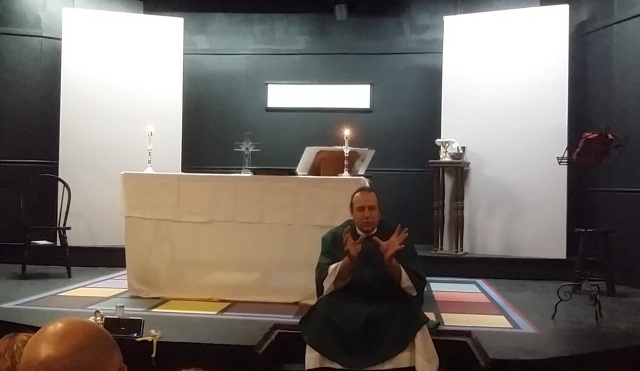
Which brings us to the next subject, because holy crap I’m wearing blue!
I should also probably not try vestment-making when I’m getting over a cold, because I saw the video and realized I don’t much care for how the chasuble drapes. And I should’ve either gone with a pillar orphrey, or sewn some 1-inch blue crosses onto the orphreys to make the vestment “pop” more.
But I digress. Every year, the Catholic blogosphere burns countless pixels ranting against “blue vestments for Advent,” always basing their stance on an argumentum ad auctoritatem and concluding that “the answer is no because the Hierarchy says so.”
They’re correct that that’s as far as they need to go, because the post-Tridentine Church is authoritarian and the post-Vatican II Church is totalitarian in orientation. (The pre-Vatican II Church never had a directory trying to micromanage popular piety, for example.) Ergo a “Lawful Neutral” stance – i.e., following rules for the sake of following rules – is all that’s relevant for them.
A different tack is used by the “Pro-Blue” side, who often claim the Sarum Use used blue for Advent (actually Blue was used for Advent at Wells, in Sweden, and, if I recall in the Mozarabic Rite; there was no record of it being used specifically for Advent at Sarum), or they misquote The Parson’s Handbook as saying such a thing (also a nothing burger).
The real reason for blue versus purple is something that’s debated to this day. The most reasonable explanation I’ve found – though I’ve no idea whether it’s true – is that the original color is black and the difference comes from the plant dyes used in different regions.
According to this explanation, cloth-dyers in northern and southern Europe used different plants for dying. Since these dyes were not colorfast, the colors would fade over time; the dyes in northern Europe would fade to a bluish color while those from southern Europe would fade to a more violet hue.
Again, I have no way to confirm this and don’t know anything about the dying processes in different regions of medieval Europe. But it does match something Pope Innocent III says in his De Sacro Altaris Mysterio, where he tells us color for Advent is black, and that violet (violaceus) may be used as a substitute. The distinction between violet and black was codified in 1570, as a part of the Tridentine Reforms. I talk about these two documents in The Magic of Catholicism.
Back to Innocent III. If he tells us black and violet are the same liturgically, then it may be a hint about the nature of plant dyes in thirteenth-century Italy. When we consider that modern colorfast dyes were only invented in the nineteenth century, it becomes easier to see this as a potential reference to color fading, while keeping the proverbial jury out pending new evidence.
This is all well and good, but it does not explain why blue vestments became mainstream in the 1960s and 1970s, even appearing at some Novus Ordo churches during the “Modernist Ascendancy” period. The reason for this was twofold: shaky scholarship on the one hand, and greed on the other.
Early twentieth century scholarship had given us the claim that blue was the Advent color in northern Europe in general and England in particular. Some adopted this as a way of saying “we’re Catholic but not Roman” (think in terms of Branch Theory), which makes sense because color is probably the most visual means available to highlight the difference between one organization and another.
The scholarship was, as I said, shaky, as medival liturgical colors followed a scheme closer to that found in Eastern Orthodoxy: dark colors for penitential seasons, bright colors for happier seasons, and the best vestments you have for high feastdays, while each region developed its own preference for which specific colors to wear on specific days. What Innocent III preserved for us was the local usage of Rome and the Papal States, which eventually spread throughout Europe in the wake of the destruction of liturgy at the hands of Reformed and Radical Protestants, the standardization of the Roman five-color scheme throughout Catholicism (displacing the local usages), and the descendants of these Protestants looking to return to liturgy centuries later, with the Roman model being the only one standing for them to work with.
In fact, we see this play out in Anglicanism during the nineteenth and early twentieth centuries. With the rise of the Anglo-Catholic Movement, there was legitimate concern over the importation of Roman materials to English-speaking soils. The solution they found was effectively tied to examining medieval English usages and emphasizing those which distinguished what they called “English Catholicism” from the Catholicism found in Rome.
In other words, it was natural for these scholars to look for something they could do to underscore the fact they were not Romans while asserting that they were, in fact, adherents of big-C Catholicism.
While the scholarship was shaky, the end result began to catch on especially in the years after Vatican II, and this is where the “greed” comes in: vestment manufacturers found themselves with an opportunity to sell more vestments, and sell them they did. This went hand-in-hand with modern liturgists telling parishes that Advent was not a time of penance, and the Church needs different colors to distinguish Advent from Lent.
(On that note I’ve also heard that in some Anglican parishes, they wear blue during Septuagesima, but I’ve never gotten specific names, dates, or places to back that up. My own preference was a bluish-violet for Septuagesima and a reddish-violet for Lent.)
This, in a nutshell, is the story of blue vestments during Advent in the churches who wear them, and the story of internet Catholics who refuse to understand anything outside of “muh rules.” With that said, the Roman Church has every right to forbid blue vestments for Advent or any other time, so it would be inappropriate to wear blue in a Roman Catholic or Novus Ordo church. Conversely, any other denomination likewise has the right to forbid violet if they saw fit to do so, even though such a move frankly doesn’t fit with the spirit of liturgical Protestantism (which historically recognizes a great deal of flexibility in how individual parishes do their liturgies).
So what are my own reasons? A year ago I posted on Facebook that blue during Advent is a good legal move, as it clearly indicates I am not purporting to be in union with the Novus Ordo Church. But there was a part of me that just wanted to try it out and see how it works. Considering that next Saturday will be cerulean and the following Saturday pink (yes, I call it pink to troll the pedants!), I’ll only have a chance to wear the blue set one more time this year anyway.
All in all, that’s what I wanted to say about blue vestments. So let’s talk about the End of the World.
The End of the World
Finally, we get to the meat of the thing! There are two Gospels for the First Sunday of Advent, one being used in the Roman Rite – I call this the “Southern Tradition” – and one being used in the majority of northern Europe and in the Carmelite Missal (I call this the “Northern Tradition”). Both lectionaries are rooted in the Comes Hieronymi tradition with the Southern Tradition preserved in the Traditional Latin Mass until this day. Likewise, the Northern Tradition was preserved by Anglicans and most Lutherans prior to the 1970s, when nearly everybody adopted some version of the 3-year lectionary.
This difference of lectionaries is also why Catholics traditionally say “Sundays after Pentecost,” while most liturgical Protestants traditionally said “Sundays after Trinity.” But that’s a minor point that’s outside the scope of our talk.
Back to my point. In the Northern Tradition, the Gospel for today would be the Triumphal Entry, linking Advent to Palm Sunday. But we use the Southern Tradition here, meaning our Gospel tells us about the end of the world. In fact, the Sequence Dies Iræ was originally written specifically for the First Sunday of Advent, and inspired by this Gospel!
So, why does the first Gospel pericope of the ecclesiastical year begin by discussing the end of the world? One way to read it is that the Church Year is a reflection of history, simultaneously looking back toward creation and looking forward to the end. The cycle of Advent really drives this home – and remember a property of this season’s Element, Water, is fluidity – and places before our minds the double-advent of the Logos.
At today’s Matins, St. Gregory teaches that Jesus “telleth us what will be the evils of the world as it groweth old, that He may wean our hearts from worldly affections. Here we read what great convulsions will go before the end, that, if we will not fear God in our prosperity, we may at least be scourged into fearing His judgment when it is at hand.”
Likewise the Old Testament Reading at Matins, Isaias 1:1-9, reinforces this theme by foretelling the end of Jerusalem and the beginning of the Exile. The world as you know it has ended, with the implication that a new world is to come.
Being Generation X, this is something I’ve experienced on a much smaller scale. I grew up in a world radically different from the post-9/11 order we find today. The world I grew up in no longer exists, and no amount of wanting it is going to bring it back. My only option is to try to understand the new world around me no matter how cringe I find the current corporate-political regime, the current popular trends, or the current social order.
The generation that grew up during World War II could say the same thing, seeing their world begin to be torn apart in the 60s, and a person born and raised in the days of stagecoaches could just as easily say the world they knew ended with the invention of the automobile. In this “micro” sense the “End of the World” can be seen as cyclical rather than linear. In fact this has a parellel in the “Particular Eschaton,” the point at which we die and are judged the first time. The world as we knew it is ended, and we are set to enter another world for eternity.
Yet Jesus is speaking in the “macro” sense in today’s Gospel. That is to say, he’s talking about the “General Eschaton,” the End of All Things and not just the world as we know it. And keeping this in mind helps us put our penance and preparation into perspective.
Let’s put it this way. Penance is useless if it doesn’t have an end goal. Preparation is useless we don’t have something to prepare for. What Jesus is saying here is to prepare for his return, and if you remain in a state of preparedness you won’t have so much to worry about.
This calls to mind the Two Advents: the first when the Logos came in the flesh and uttered these words, the second when he will come again in glory to judge the living and the dead, of whose kingdom there shall be no end.
Every penance we perform is intended to keep us in that state of preparedness, or to get us there if we aren’t already. In effect the penitential nature of Advent calls us to be “Doomsday Preppers” in the fullest spiritual sense possible, just as does the Parable of the Seven Virgins or the Parable of the Talents. Yet that penance and that prepping are unequivocally tied up with the joy we shall feel when he bids us to enter his Kingdom!
This is also what makes the penitential nature of Advent different from the penitential nature of Lent, in which we take a fuller purification to ready ourselves for the season of Easter. In the rites of Holy Week, most notable the Chrism Mass and the Easter Vigil, we see the process of old items being retired and all things being made new. This newness, this yearly renewal, is the spiritual preparation we have in view during Lent and Easter, a purification that keeps us grounded in the present moment and the present plane. Yet Advent’s penitential nature is of a more heavenly sort, calling us to focus our eyes on the reason we undertake these purifications to begin with, and furnishing us with a reason to keep ourselves in as much a state of spiritual purity as possible.
Which brings us to today’s Epistle, wherein Paul tells us the night is over and the dawn is coming. This is the perfect reading to summarize the season, this interplay between night and day, and to be ready for when the day comes.
And may the peace of God, which passeth all understanding, keep your hearts and minds through Christ Jesus. Amen.







 THAVMA: Christian Occultism and Magic in General