
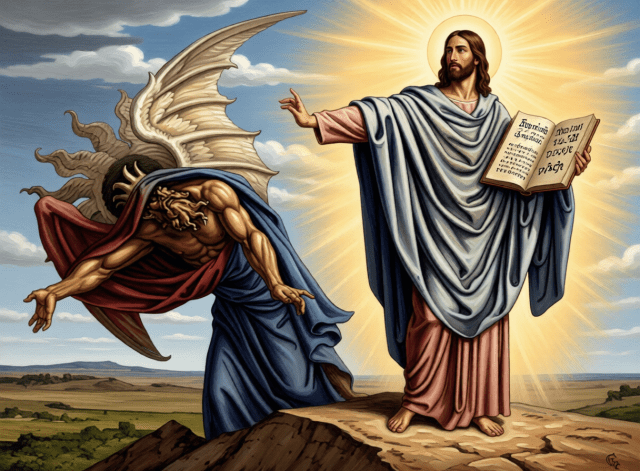
Original working title: “Casting Out the Works of Darkness”
I thought I’d run out of things to say here. My personal practice continues, of course, and I’ve thrown all my energies into the Fellowship of the Inner F.I.R.E. And as far as the modern-day occult community is concerned, I’ve increasingly felt like an outdated relic from the 90s.
Lucky for us, God has a sense of humor.
On Facebook awhile back, I posted about “making a pivot” and brought up some of my concerns with the current-year occult community, wondering whether the word “occult” is even accurate for what I’m doing, or if the word’s meaning had simply become co-opted into something different from when my younger self was learning and studying. Here’s the gist of what I said:
It’s dawning on me that maybe I’m using the word “occult” wrong. Or maybe the word has taken on a different meaning than it used to.
I’m a creature of the 90s, and my learning period started in the late 80s. That period is my “home,” and I’ve no need to follow trends or “update” or “stay current.”
In the authors I read while coming up, the words “occult” and “esoteric” were used interchangeably. Both pretty much referred to “that which is hidden,” and may or may not have left room for interpretation. I say “may or may not” because my early learning was solitary and I never got involved with a lodge or order.
Nowadays the word “occult” seems to be more geared towards Crowleyanity, Demonoduly, so-called “folk saints” that are oftentimes anything but holy, a lot of anti-Christianity, and outright Satanism. Often combined with far-left political screeds.
That ain’t me. I want nothing to do with any of that. I refuse to be associated people who do those things.
The point is: I may have been using the word “occult” incorrectly, and that’s caused me a lot of grief. Or the word “occult” has been compromised by bad actors, which has still caused me a lot of grief.
The fact I’ve been treated like a pariah in exoteric circles while Jonathan Pageau gets celebrity status for saying ALMOST THE EXACT SAME THINGS I’VE SAID SINCE 1998 is proof of how much grief that word has caused me.
I’m not looking for “respectability” in the eyes of exoteric believers. I stopped caring about the moment I left ministry in 2015. I’ve just gotten tired of being confused with beliefs and practices that I not only do not endorse, but some beliefs that make me sick to my stomach.
I’m not looking to bash anybody or their beliefs, because frankly I’ve got too much on my plate to care what anybody else believes or practices. I’ve no interest in going any further than drawing clear lines of dissociation.
As pointed out above, the “demons are your friends” ethic currently trending within the occult scene not only runs counter to everything I learned and was taught, it basically tells the world that the exoteric Church was right all along!
Fortunately the comment section gave food for thought, ranging through a spectrum of quality as social media comments often do. What I write here incorporates insights from the better end of the commentaries.

Occultism and Esotericism
Let’s start with some basic terms: “occultism” and “esotericism.”
These terms do not mean the same thing. But when I was coming up, they were used more or less interchangeably.
The word “occult” simply means “hidden.” It could also imply “private,” as in “where nobody else can see it.” These meanings are found in pre-Vatican II Moral Theology textbooks, which commonly distinguish between actions committed in the “open forum” or the “occult forum.” This is simply a public/private distinction with no implication of the magical or preternatural.
(These same textbooks deal with magic in its own section, usually under the subdirectory of “Sins Against the First Commandment→Idolatry→Superstition.”)
The word “esoteric” is a little bit more complicated. I had always thought it to mean “inner” or “that which is within” (as contrasted to “exoteric” or “that which is without”). It turns out I wasn’t completely correct.
According to Wiktionary, the word “esoteric” has three meanings:
1) Intended for or likely to be understood by only a small number of people with a specialized knowledge or interest, or an enlightened inner circle.
2) Having to do with concepts that are highly theoretical and without obvious practical application; often with mystical or religious connotations.
3) Confidential; private (synonym “secretive”).
The third definition almost synonymous with “occult,” so we’re at least in the ball park. The second definition is kind of hit-or-miss, seeing I generally like to keep an eye on practical applications. The first definition comes close to another meaning given in the comments: “for the few.”
But again I was only partially correct, because I wasn’t looking at the word “esoteric” in terms of exclusivity. I was using it in the sense of “material that’s hidden inside the tradition but anyone can find with enough diligence and patience.” And, standing on my own reading of Tomberg’s discussion of the “Church of Peter” and “Church of John,” I’ve always insisted that the esoteric must not be alien to the exoteric but fit within its theological skeleton.
That is to say, all esoteric interpretations must conform to and be compatible with formal theology. This is my limiting principle which prevents one from going too far off the rails.
So far so good. But then, when I encounter so much of what’s actually passed off as “Esoteric Christianity,” what I see is often anything but. Theological method is typically ignored, and most of what I see is either bad word studies or incomprehensible gobbledygook that may not have made sense even to the original author!
So I begin to question if the word “esoteric” is valid for what I’m doing here, even if only on a descriptivist level. I may be at least somewhat within the “prescriptivist” or dictionary-definition usage of the word, but I’m swimming against a mighty current when it comes to the “descriptivist” meaning, or how the word is used in real life!
The Magical and the Mystical
Everybody has their conception of the word “magic,” which makes it notoriously slippery to define. Most people will agree that there’s a vague sense of “making things happen through spiritual or otherwise non-physical processes,” though arguments begin when we start trying to nail down a precise definition.
The real issue in these arguments seems to be the separation of magic from religion.
For myself, the two are one and the same, or to be more precise, magic is a practical application of one’s belief system. Hence my definition of magic as “applied theology.”
Let’s unpack this a little. Theology is classically defined as “faith seeking understanding” or, as I believe it was Paul Tillich who said, “rational inquiry into the contents of one’s faith.” Our theology is our understanding of what we believe.
With that said, magic is intertwined with belief. In other words, a magician is unlikely to try a method he or she doesn’t believe in, or to work along the lines of a doctrine that he or she doesn’t believe in. Rather, the magician works from how he or she believes the universe to work, using methods in line with his or her personal belief system. It doesn’t matter whether the individual magician is Christian, Jewish, Pagan, or even Atheist, everyone has a belief in something and that’s the belief brought to circle, triangle, or mensa.
So with this in mind, an individual’s operation of magic is inseparable from their private set of beliefs, or in other words inseparable from their private theology.
Let’s take this a little further. In comparative religion books I’ve read from the early 20th century, there’s a take that magic is simply the private exercise of religion. That is to say religion is the calling of spiritual powers for the benefit of the whole community, while magic is the calling of those same spiritual powers for the benefit of the individual. I’m not sure whether to endorse this, even though it’s in line with my take on magic as “applied theology.”
What I reject is Moral Theology’s definition of magic as “explicit or tacit invocation of demons” or “works performed with the help of the devil,” because it’s disingenuous in limiting magical practice simply to the “dark side” of the coin, and when I was coming up most magicians were taught to avoid the demonic and everything that comes with it. In the last analysis it’s the Institutional Church working a marketing angle, or as I put it years ago: “They’re selling you Coke while we’re selling you Pepsi.”
What I reject even more categorically is Crowley’s definition that “Magick [sic] is the art and practice of causing change in conformity with Will.” And not just because his doctrine of “True Will” strikes me as too Protestant for me to take seriously. I reject it because the definition is too broad, so much so that even using the toilet becomes a magical act!
Likewise I also reject the spelling of magic with a “k.” I reject the spelling because it’s supposed to refer to “occult magic,” yet occult by its very nature means “hidden.” An alternate spelling is only publicly lampshading something that is intended to be secret, thus defeating the entire purpose. Now you can come at me all you want with “it’s an older spelling” or what linguists used to call the “Saxon ‘k,’” but in the end I’m only concerned with the practical aspect. And that aspect is the keep the hidden stuff hidden, even better if it’s hiding in broad daylight!
So much for magic. Now let’s talk about mysticism and the mystical.
If we go back to Wiktionary, the word “mystic” is defined either as “someone who practices mysticism,” or as follows:
1) Of, or relating to mystics, mysticism or occult mysteries; mystical. (Synonyms: mystical, sorcerous, sortilegious)
2) Mysterious and strange; arcane, obscure or enigmatic. (Synonyms: cryptic, ill-defined, mysterial)
If we go to the related word “mystical,” we find this:
1) Relating to mystics or mysticism. (Synonyms: mystic, sorcerous, sortilegious)
2) Having a spiritual or magical significance that transcends human understanding.
3) Inspiring a sense of spiritual mystery, awe, and fascination.
This seems closer to what I’ve been talking about all these years. Nothing I’ve talked about has ever been intended “for the few” or “for the inner circle,” even though it is “obscure” and has been “hidden.” Realistically only a small percentage of the population would have the interest in finding the material, because it’s buried within the trunk of exoteric religion and uses exoteric terminology.
And let’s be blunt: many moderns have either have bad memories connected with exoteric religion, or they’re otherwise turned off by the tedium of having research underneath the surface. This is before you factor in the majority of exoteric devotees, who believe the party line that it’s a “sin” to dig too deep or ask too many questions. (The Catechism of the Council of Trent actually says curiosity is a sin, and the Novus Ordo catechism asserts the faithful are to be “docile” to the hierarchy. Other traditions have their own types of barriers).
What Are We to Do?
Let’s take a look at this. On the “occult” plant I reject demonoloatry and demonoduly, I reject the “left hand path” as the West understands that term, and I have no truck with Thelemites, Satanists, Setians, Chaos Magicians, and others that make up the bulk of the modern-day occult community.
Likewise I completely and totally anathematize the politicization within the current-year occult community, whether Left or Right (even though we all know it’s mostly Leftists). Politics is a thing of the collective, where as I see magic as a path of individual liberation and an intensely private thing. The purview of the individual is not the property of the collective, and collectivists of all stripes can take a long walk off a short pier.
On the “esoteric” plank I don’t really have much use for a lot of what people talk about nowadays. For example I’m pretty disinterested in Guenon or Evola. I’d be interested in reading up on Steiner though engaging with his followers often gives me more of a headache than talking to Orthobros or Fundamentalists (I think I repeated myself!). I like Tomberg and much of Swedenborg. Much of what else is considered “esoteric” I think of as a mixed bag, running a spectrum of quality. (For what it’s worth I don’t consider my own work particularly high quality, just the best I can do with what I’ve learned and am able to understand.)
The more I think about it, I’m pretty sure I’m using the words “occult” or “esoteric” correctly, or at least within the ballpark.
But then words change meanings over time. For example when I was in kindergarten in 1979, the teacher told us the word “gay” meant “happy.” And this is after the word had already changed its meaning pretty drastically! Now imagine the confusion of a time-traveler from the 1940s coming to 2026 and telling people he’s “feeling pretty gay today.”
That brings us back to the Facebook post I mentioned above, and some commenters said that “yes, people are changing the meaning.” One even said “the occult community has gone full temu,” which may not be completely true but still made me laugh more than it should have.
Yet here I am. I am happiest and most comfortable with 80s and 90s-style occultism even if it’s my own version, my own adaptation. Even if the rest of the community’s moved on.
Here I stand, I can do no other. So help me God!
What About Your Next Post?
And if you’ve read this far, you may be wondering “When is your next post? Or are you just going to ghost us again?”
The answer to that is “I don’t know.” I’ve found that it depends on if there’s anything I care to say. If I try to force myself to post regularly, then it falls apart because I either run out of things to say, or manufacture something that’s too poor quality to be worth writing (this latter I think of as disrespectful to you, the reader).
In the meantime I’ve taken to posting regularly (or at least semi-regularly) at the Fellowship’s website, and am working on “Magico-Liturgical Explorations” as a not-yet published series (it will be published once I finish all the installments). The site also has its own Free .PDF Library with a different “flavor” than here at the THAVMA site, and I’ll soon be publishing our first guest contribution from our newly-ordained Deacon Brandon (whom I ordained this past Saturday in Muncie, Indiana).
The Fellowship is also looking to schedule a monthly “discussion circle” open to the public, where we discuss our personal spiritual and/or magical practices and trade notes with each other. This is very similar to what takes place in our after-Mass chats, and will be hosted over Zoom so everybody can attend.
Last but not least I’m still active over on Facebook. Now I’m a little reticent about friend requests largely because I don’t know who’s an AI and who’s a human being. So interact with me so I know you’re human, and I’ll be happier to hit the “confirm” button.
So there is still activity going on, even if it’s not on this particular website. If you’d like to get involved with what we’re doing, just drop us a line!


Hello from Ireland. Great post. I got my occult education in the 80s from the few books i could find so i know exactly where your coming from. It was a time, espically here when occult really did mean occult i.e hidden. Theres a scene in “whitnail and I” a great movie set in the late 60s where one of the characters says “they’re selling hippie wigs in woolworths, the sixties are over.” It most definitely feels like that. On the other hand its good that everybody and their granny seems to be exploring areas that were beyond the pale when i was growing up. it will all work out in the end.
LikeLike
Greetings! Y’know sometimes I still remember those days like yesterday. The Satanic Panic was in full swing but most of us just thought the movies were great and the music was awesome.
I’ve never seen “Whitnail and I” but completely identify with the sentiment. Cheers!
LikeLike
Wow! glad to hear from you! Thought you stopped doing your thing. john
LikeLike
You should check out foolish fish. They just had a talk about the subject matter, very good! Here’s the link The Occult (and ACTUALLY doing magic) w/ Denis Poisson [Foolish Fish] The Occult (and ACTUALLY doing magic) w/ Denis Poisson [Foolish Fish] – YouTube
LikeLiked by 1 person