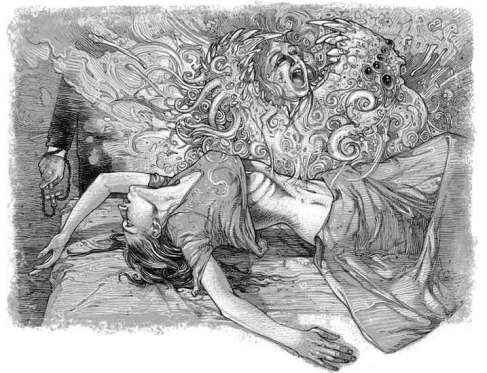
Back in 2022, I included a section on hymns and exorcism in The Big Book. That section resulted from an experience that happened one night while praying Compline, which led to a rabbit hole I’ve yet finish investigating.
That said, circumstances have changed since then, and a failed zoombombing attempt on the Feast of Epiphany inadvertently led to the foundations of a “cyber-parish” with a solid core group. That, and the passing of my last parish’s organist last week, led to me thinking about music more often.
These streams converged this morning, when my still-waking mind started composing exorcism lyrics to the tune of “Agincourt.” The tune’s certainly appropriate, considering its original words comemmorate victory in battle.
After some time sitting down and hammering out the words, here’s what I came up with. Influences are drawn from the Rite of Exorcism, the demon-attributions of the Bible, the Lanterne of Light, from Sebastien Michaelis’ Admirable History, from CLM 10085, from my unpublished practice, and from a correct usage of Mary’s title Empress of Hell. I openly acknowledge the wording could use some tightening-up in a few places.
Will it work? Will anybody sing it? Will I place it in the new hymnal I’ve been working on? I’ve no idea.
But without further ado . . .

A Hymn for Exorcism
Text: Agostino Taumaturgo, 2024. CC-BY-NC license.
Tune: Agincourt, LM. English folk melody, 15th century.Begone, thou Satan, we demand,
By Jesus Christ our Lord’s command!
Who in the day of righteous ire
Shall judge both quick and dead by fire!Lucifer, prince of pride most dire,
Behold the price of thy desire!
Thou failed to place thyself on high,
Cast to the pit to rage and cry!Asmodeus, thou prince of lust,
We cast thee out with full disgust!
May the Archangel Raphael
Send all thy servants back to hell!O Mary, thou Empress of hell,
Return these monsters where they fell,
And may thy Son in righteous ire
Judge them and all their hosts by fire!Beelzebub, the envious,
We order thee, cease and desist!
Saint Peter, who opposes thee
Shall grant to us the victory!Satan, of wrath the prince thou art,
Again we order thee to depart!
May good Saint Michael, whom we call,
Bind thee in hell, once and for all!Thou heinous demon, Astaroth,
Or Abbadon, the prince of sloth,
Bartholomew opposing thee
Shall cast thee out eternally!O Mary, thou Empress of hell,
Return these monsters where they fell,
And may thy Son in righteous ire
Judge them and all their hosts by fire!Mammon, the av’rous demon-prince,
Thine oyster the world’s circumf’rence,
Saint Martin’s generosity
Will drive thee to obscurity!Belphegor, prince of gluttony,
Thou temptest to obesity,
May all the Saints in heaven’s court
Send thee away and all thy sort!Behold the cross of Christ the Lord!
Begone ye enemies of the Word!
The Lion sent from Juda’s tribe
Conquereth all, from David’s side!O Mary, thou Empress of hell,
Return these monsters where they fell,
And may thy Son in righteous ire
Judge them and all their hosts by fire!Nakakon, Farfax, Marimon,
And Paymon, by Tetragrammaton!
We cast ye out, ye demon-kings,
No more cause woe or suffering!By the most potent names of God,
Saday, Ah-gah-lah, Yod-He-Vav!
Shall all demons be cast away,
Back to the pit and burn for aye!The Father, Son, and Holy Ghost
Cast out the devil and his hosts,
By Christ, who shall in righteous ire
Judge all the universe by fire!O Mary, thou Empress of hell,
Return these monsters where they fell,
And may thy Son in righteous ire
Judge them and all their hosts by fire!


“Hello! “I write from Brazil!” I’ve been following your blog for a few years now, and it was instrumental in my decision to become Catholic, having been raised in a Protestant family.Thank you very much!However, I have a doubt not necessarily related to the post, I’m really confused and would like to ask for clarification: in one of your posts, you say that the Isagoge of Arbatel can be safely practiced by both Catholic and Protestant magicians. But what confuses me is that one of the Olympic spirits, Och, can make someone worthy to be worshiped as a deity by the kings of the whole world.I wonder if the above was an allegory to “troll” the unwary, or the greedy, because the Bible says that only God should be worshiped. I think Arbatel is very much about allegory, but I still get somewhat confused about the legitimacy of the author’s guidance, whoever he may be.Are the powers of the Olympic spirits mainly allegorical? If so, what did the author mean or convey with “to be worshiped as a Deity”? If it’s not so allegorical, then “there are more things in Heaven and Earth than are dreamt of in our philosophy”?I’m restless because I really feel called to work with this grimoire, but I chose to be Catholic first and an occultist second; both are important to me, but God and the Church come first.If I sounded somewhat aggressive in my questioning, I apologize. I’m grateful in advance for everything your blog, YouTube channel, and books have done for me. Truly”.
LikeLike
Hi there! No, you don’t sound aggressive at all, and in fact you’re right to point this out.
To be perfectly honest, that part about Och had slipped my mind when I was writing. I’m not going to make any excuses for that. I certainly would not wish to be “worshiped as a deity,” though there are people in the world who would absolutely crave such a thing. I will not try to guess the intentions of the Arbatel’s author.
Descriptively speaking, the grimoire has been and continues to be used by both Catholic and Protestant magicians, though whether it may be used without sinning is another question entirely. I believe it can be used without sinning provided one does not seek to be “worshiped as a deity,” or some other immoral purpose. Reading between the lines is important here.
LikeLike